
Cold email AI tools refer to software that assists with creating, sending, and managing unsolicited outreach messages by applying machine learning and automation. These tools typically analyze recipient data, generate or suggest message content tailored to specific segments, and schedule sequences across time to support coordinated outreach. Their role is to reduce repetitive tasks, help scale outreach workflows, and supply analytics that describe activity such as opens, replies, and bounce behaviour. Discussion of these systems focuses on how automated personalization and workflow orchestration interact with email deliverability and sender reputation concerns.
Functionally, cold email AI tools combine several component capabilities: natural language generation for subject lines and body text, rule-based sequence management for follow-ups, segmentation logic to group targets, and telemetry dashboards for campaign performance. Integration with contact lists and customer relationship systems often enables more context-aware messaging and deduplication of contacts. Legal and ethical considerations such as consent, anti-spam regulation, and data handling practices are relevant to how organizations deploy these tools and interpret their output.
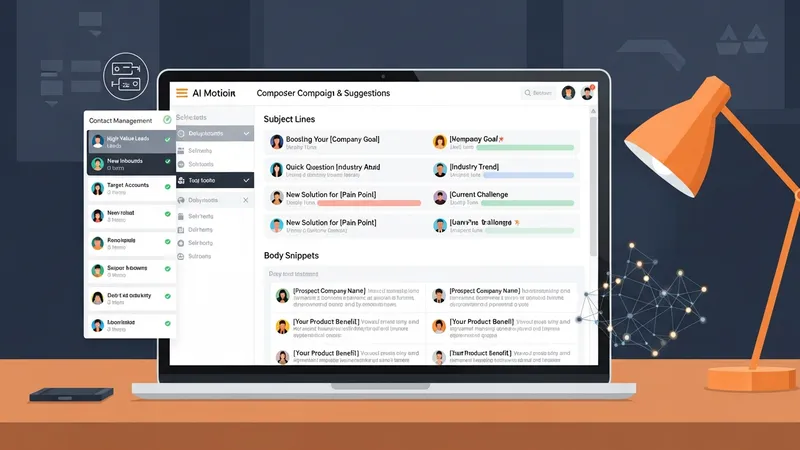
One practical dimension is how personalization is implemented. Personalization may range from simple token insertion (name, company, role) to context-aware sentence rewrites that reflect publicly available information. Machine learning components can suggest phrasing or subject lines that align with recipient profiles, but quality depends on the input data and models used. Organizations commonly find that clearer, structured data about recipients yields more relevant personalization; conversely, poor or stale data can generate inaccurate or awkward outputs that require human review.
Another key area is workflow automation and sequence management. Tools typically allow users to define timing, conditional branches, and retry rules for follow-up messages. Automation can reduce manual scheduling work and maintain consistent cadence across outreach lists; however, automated sequences may interact with deliverability systems and spam filters in complex ways. Monitoring campaign metrics and gradually ramping volume are often cited as prudent measures to observe how an account’s sending reputation develops over time.
Audience segmentation and list hygiene are central to effectiveness and compliance. Segmentation may be driven by firmographic or behavioral attributes and can influence which templates or personalization strategies are applied. Robust list hygiene routines — deduplication, bounce handling, and suppression for unsubscribes — typically reduce negative signals that affect deliverability. Tools that integrate with external contact sources or CRMs often include synchronization capabilities that can help preserve segmentation fidelity across systems.
Analytics and deliverability features provide insight into campaign health and recipient engagement. Standard telemetry includes opens, replies, click-throughs, and bounce rates; some systems estimate deliverability risk or flag accounts that may be receiving heightened complaint rates. Interpreting these metrics often requires contextual understanding: for example, a higher open rate may reflect subject-line changes, while a low reply rate might indicate targeting misalignment. Many teams treat analytics as diagnostic information to inform iterative adjustments rather than definitive performance guarantees.
Security, privacy, and compliance factors influence how organizations choose to deploy cold email AI tools. Data handling practices, storage locations, and support for export or deletion requests can determine suitability for particular legal regimes. Anti-spam laws and email provider policies typically govern acceptable sending volumes and consent expectations. Legal and policy constraints often mean that human oversight and documented processes are part of responsible use, particularly where personal data or cross-border transfers are involved.
In summary, cold email AI tools combine automated personalization, sequence automation, segmentation, and analytics to support organized outreach. Their performance may depend on data quality, configuration, and adherence to deliverability and legal norms. The next sections examine practical components and considerations in more detail.
Feature sets in cold email AI tools typically map to a few consistent categories: content generation, sequencing and scheduling, contact management, deliverability safeguards, and reporting. Content generation may include template libraries, subject-line suggestions, or AI-assisted rewrites that aim to match tone and context. Sequencing enables conditional logic and timed follow-ups, often with pause conditions for replies or other signals. Contact management handles list import, deduplication, and CRM synchronization. Deliverability safeguards commonly offer domain and IP warm-up guidance, suppression lists, and bounce classification. Reporting aggregates engagement metrics and may export to analytics stacks.
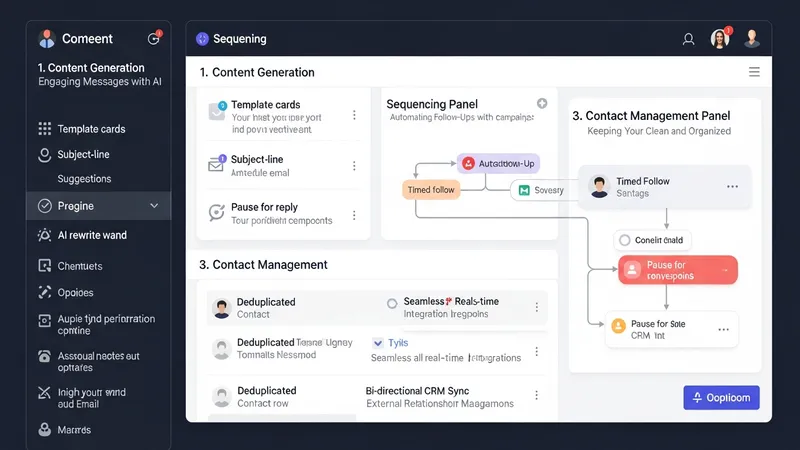
When evaluating these feature categories, practitioners often consider interoperability and data flow. Integration points with CRMs and marketing platforms can reduce manual duplication and keep personalization tokens current. Data flows that permit two-way sync help maintain consistent contact states across systems, which can reduce the risk of sending duplicate or misaligned messages. Security-conscious teams may also review API access controls, role-based permissions, and logging features to ensure traceability of automated actions within outreach sequences.
Deliverability-related features may include monitoring for soft and hard bounces, complaint rates, and spam-trap indicators. Some tools provide domain warm-up sequences or guidance on gradually increasing send volume. These functions typically aim to preserve sender reputation across major email providers. Users should treat deliverability signals as early warnings and couple them with list hygiene and authentication configuration (SPF, DKIM, DMARC) to influence inbox placement; these are technical considerations that often require coordination between outreach users and infrastructure teams.
Reporting and attribution capabilities may vary from simple dashboards to more detailed exports for statistical analysis. Commonly reported metrics include open rates, reply rates, click rates, and bounce counts; some platforms also report deliverability metrics or integrate with analytics tools for conversion tracking. Interpreting these metrics typically requires context about list sourcing, industry norms, and campaign intent. Organizations often combine automated reports with manual review to refine segmentation and message content.
Personalization methods range from deterministic token replacement to context-aware language generation. Deterministic methods insert known fields—name, role, company—into templates and are straightforward to audit. Context-aware generation uses models that can rewrite sentences or suggest content based on public signals such as a prospect’s recent announcement or online profile. These model-driven methods may produce more variable output and typically require validation workflows to prevent inaccuracies. Campaign teams commonly implement human review steps or conservative templates when relying on generative personalization.

Data sources for personalization influence output fidelity. Internal CRM records, firmographic databases, and publicly available profiles can provide signals for tailoring messages. The quality, recency, and structure of those data points often dictate how safely automated personalization can be applied. Practitioners frequently note that enriching contact records and establishing canonical fields (e.g., verified company names, standardized titles) can reduce mismatches and context errors in generated text, thereby limiting potential reputational risk.
Balancing personalization depth and scalability is a practical consideration. Highly customized messages may improve relevance for certain segments but require more human effort or higher-quality data. Conversely, fully automated, lightly personalized sequences scale more easily but may yield lower engagement if the content lacks specificity. Teams may use segmentation rules to apply deeper personalization to high-value segments while using simpler templates for broader audiences; these are planning trade-offs rather than rigid prescriptions.
Auditability and traceability are often discussed when personalization includes generative elements. Keeping logs of generated text, the data fields used, and the model version can help diagnose mispersonalizations or respond to recipient inquiries. Where regulations require certain records about automated decisions, these logs may also support compliance. Therefore, organizations may choose tools whose architectures facilitate exportable histories of generated messages and the inputs that produced them.
Workflows for automated outreach commonly involve stages for list preparation, message design, sequence configuration, monitoring, and reconciliation with downstream systems. Integration with CRMs, recruitment systems, or marketing databases often affects how contacts are routed and synchronized. Two-way integrations that update CRM records on replies or bounces can reduce manual reconciliation work. Workflow design may also include guardrails, such as suppression lists or pause conditions, to reduce negative interactions with recipients and maintain cleaner sender reputation metrics.
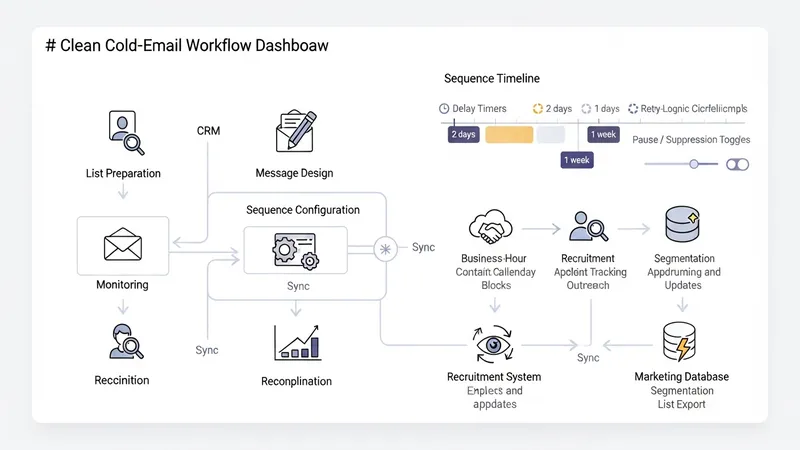
Timing and cadence settings are practical levers in sequence configuration. Tools typically let users set delays between steps, identify business hour windows, and specify retry logic after bounces or soft errors. These parameters may influence engagement signals and deliverability; for example, sending high volumes within short windows can trigger provider throttles. Many teams adopt gradual ramp-ups in send volume or segment sends by IP/domain to observe how delivery outcomes evolve, viewing these changes as empirical observations rather than guaranteed improvements.
Integration mapping should consider identity resolution and deduplication. When contacts exist across multiple systems, matching logic (email address normalization, canonical identifiers) matters to prevent duplicate sends. Some integration architectures use unique keys or hashed identifiers to link records across systems. Where this linking is imperfect, suppression and deduplication steps within the outreach tool can reduce accidental repeats. These are operational considerations to manage contact lifecycle integrity across platforms.
Operational governance often addresses role assignments, approval flows, and retention policies for templates and contact lists. Setting limited role permissions for sequence publishing, establishing template review steps, and defining retention windows for contact data can help manage risk. Organizations may treat these governance elements as internal controls to ensure consistent use and to document rationale for outreach practices, rather than as features that guarantee compliance.
Measurement frameworks typically combine engagement metrics with deliverability indicators to form a holistic view of outreach health. Metrics such as open rate, reply rate, click-through, bounce rate, and complaint rate are commonly tracked. Analysts often correlate these metrics with list source, template variants, and sending volume to identify patterns. Because industry baselines vary, many teams treat these metrics as comparative signals over time for the same programs rather than absolute benchmarks. Ongoing measurement supports iterative adjustments and risk awareness.
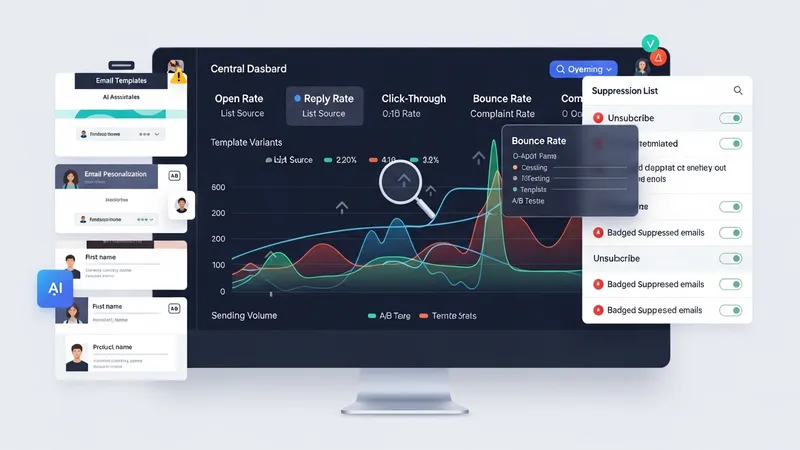
Compliance with email regulations and provider policies is a continuous maintenance task. Anti-spam statutes vary by jurisdiction and may require consent mechanisms, clear identification, and unsubscribe handling. Provider policies can change and influence acceptable sending behaviours. As a result, many organizations maintain up-to-date suppression lists, clearly documented unsubscribe handling, and audit trails that show how consent or legitimate interest was evaluated. These practices are presented here as common considerations rather than exhaustive legal advice.
Maintenance activities include list hygiene, deliverability checks, and model updates where AI components are employed. Regularly removing hard bounces, cleaning inactive addresses, and reconciling suppression lists typically reduce negative signals. For tools that include AI-generated content, periodic review of model outputs and prompt tuning or template adjustments may be necessary to maintain quality. Teams often schedule maintenance tasks on recurring cycles and incorporate monitoring alerts to flag anomalous patterns quickly.
Finally, privacy and data management practices interact with outbound automation. Where contact data includes personal information, retention schedules, access controls, and deletion processes may be required by law or internal policy. Exportable logs and clear records of data provenance can assist in responding to data subject requests or audits. These are operational safeguards frequently considered when selecting or operating cold email AI tools, described here as considerations rather than guarantees of compliance.